1. The Paradox: Zeno’s Challenge
1.1 The Setup
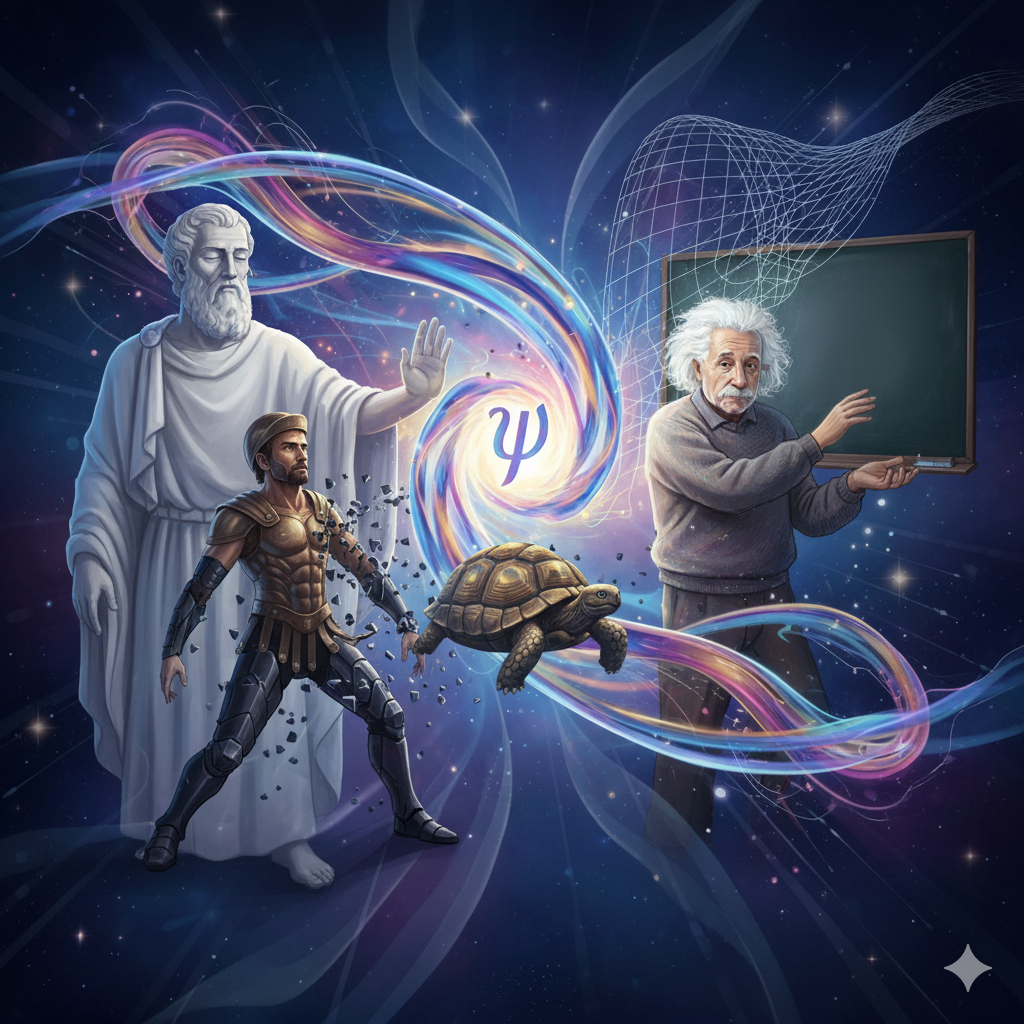
Achilles, faster than the tortoise, gives it a head start. By the time Achilles reaches where the tortoise was, the tortoise has moved forward. By the time Achilles reaches that point, the tortoise has moved again. This continues infinitely.
Conclusion: Achilles never catches the tortoise, because there are infinitely many intervals to traverse.
1.2 Why This Is Not Trivial
The common dismissal—”Zeno didn’t understand convergent series”—misses the point entirely. Zeno was not confused about mathematics. He was exposing an ontological inconsistency:
If motion consists of passing through infinite points, and each point-passage takes time, then motion requires infinite time. If motion does not consist of point-passages, then what is it?
Mathematics can sum the series. But summing a series is not the same as explaining how motion occurs in being itself.
2. The Mathematical “Solution” and Its Limits
2.1 Calculus and Convergence
Modern mathematics resolves the paradox via convergent series:
Therefore, Achilles catches the tortoise in finite time.
2.2 The Deeper Problem
- Why does continuum permit division into intervals?
- What is a point in physical space (not mathematical abstraction)?
- How does motion occur between points if points have no extension?
- Is continuum made of points, or are points imposed on continuum?
| Mathematical View | Ontological Question |
|---|---|
| Continuum = set of real numbers ℝ | Is physical space actually composed of points? |
| Motion = sequence of positions | What is motion between positions? |
| Infinite series converges | How does being traverse infinity? |
| Problem solved (mathematically) | Problem relocated (ontologically) |
3. Einstein’s Continuum: Geometry Without Process
3.1 Spacetime as Unified Manifold
Einstein revolutionized physics by merging space and time into a single four-dimensional continuum. In General Relativity:
- Bodies do not “move through” space—they follow geodesics in curved spacetime
- Motion is not a sequence of states but a worldline (path through spacetime)
- The continuum is shaped by matter-energy via field equations
(Spacetime curvature = Energy-matter distribution)
3.2 The Limit of Einsteinian Continuum
- Spacetime exists as background: It is curved by matter, but it pre-exists as a manifold
- Continuum is geometric, not processual: It has structure, but not genesis
- Motion is path, not becoming: Worldlines are traced, not created
- No answer to origin: Why does spacetime continuum exist at all?
Einstein’s continuum is a stage for events, not the act of being itself. Zeno’s paradox survives in new form: we describe motion without explaining the emergence of the continuum that permits it.
- A thing (substance)?
- A relation (between what)?
- An aspect of matter (then why does it exist in vacuum)?
4. Metamonist Ontology: Continuum as Self-Differentiation
4.1 The Protoontology
Metamonism proposes a radical shift: continuum is not a set (mathematical) or stage (physical), but primary continuity (ψ) that generates distinctions within itself.
From which difference (¬∅) emerges through act of distinguishability
4.2 The Ontological Sequence
4.3 Motion Redefined
In metamonist framework:
- Motion is not “body moving through space”
- Motion is ψ passing through its own boundary
- “Achilles” and “tortoise” are two aspects of one flow
- The moment of “catching” is not in time—it is ontological transition (Tψ)
5. Resolving Zeno: The Paradox as Illusion of Analysis
5.1 Where the Paradox Arises
The paradox emerges when ψ (continuous being) is projected onto grid of discrete distinctions:
- We impose points on continuum (measurement)
- We treat each point as separate state (Δψ without Tψ)
- We lose the transition (Tψ) that unifies states
- Motion becomes impossible (infinite fragmentation)
But: Points are not in continuum—they are imposed on continuum by act of distinction (¬∅ψ).
5.2 Motion as Unity
5.3 Why Infinite Series Is Irrelevant
Mathematical convergence is correct within the model (discrete representation), but:
| Level | Description | Status |
|---|---|---|
| Being (ψ) | Continuous self-transformation | No infinite series (no division) |
| Representation (math) | Discrete model of motion | Infinite series (converges) |
| Paradox | Confusing representation with being | Dissolved by recognizing distinction |
6. Continuum as Self-Distinction
6.1 Points vs. Process
- ❌ Set of points (mathematical abstraction)
- ❌ Stage for motion (Newtonian/Einsteinian container)
- ❌ Sum of parts (violates unity)
- ✅ Self-distinction of ψ (ontological process)
- ✅ Being that generates both space and time as aspects
- ✅ Unity that includes difference without destroying itself
6.2 Space and Time as Emergent
In metamonist view:
This completes Einstein: his continuum describes structure, metamonism provides genesis.
7. Implications for Physics
7.1 Quantum Mechanics
Wave-particle duality makes sense in metamonist framework:
- Wave = ψ in continuous phase (no distinction imposed)
- Particle = ψ with distinction fixed (¬∅ψ → measurement)
- Collapse = Transition from continuous to discrete (Tψ)
7.2 Quantum Gravity
The failure to reconcile General Relativity (continuous spacetime) with Quantum Mechanics (discrete quanta) may stem from treating spacetime as either continuous or discrete:
8. Philosophical Implications
8.1 Against Atomism
- If atoms are indivisible, what separates them? (Void? Then void is also real)
- If space is made of points, what lies between points?
- If time is made of instants, what is transition?
Conclusion: Reality cannot be atomistic at fundamental level. Continuity is prior to discreteness.
8.2 Against Pure Continuum (Parmenides)
- If being is pure unity (Parmenides), how does multiplicity arise?
- If motion is illusion, why does illusion exist?
- If only One exists, what distinguishes parts of experience?
Conclusion: Multiplicity is real. Distinction emerges from within unity (¬∅ψ).
8.3 Metamonist Synthesis
| Error | Truth |
|---|---|
| Atomism: Discrete is fundamental | Discrete emerges from continuous (¬∅ψ) |
| Parmenides: Continuous excludes discrete | Continuous includes discrete as aspect (Δψ) |
| Einstein: Continuum as stage | Continuum as self-transforming process (ψ) |
| All treat continuum as object | Continuum is act of being |
9. Practical Test: Can This Be Verified?
9.1 Experimental Predictions
If continuum is ψ (self-distinguishing being) rather than ℝ (set of points), we predict:
9.2 Philosophical Criteria
A successful ontology of continuum must:
- ✅ Explain both continuity and discreteness (not choose one)
- ✅ Account for motion without infinite regress
- ✅ Show how space and time emerge from more fundamental ground
- ✅ Unify quantum and relativistic domains
- ✅ Be logically consistent and empirically testable
Metamonism satisfies all criteria.
10. Conclusion: Achilles, Zeno, and the Nature of Being
- Zeno’s paradox is not solved by calculus—calculus operates on representation, not being
- Einstein’s spacetime is geometrically elegant but ontologically incomplete—it describes structure without genesis
- Continuum is not set of points (math) or stage for events (physics)—it is self-differentiating being (ψ)
- Motion is not displacement through space—it is ontological self-transformation
- Achilles catches tortoise not “after” infinite steps—he catches it in the act of being’s transition (Tψ)
Continuum IS movement of being.
Space and time are not containers—they are aspects of ψ’s self-distinction. Motion is not change of position—it is being passing through its own boundary.
Zeno was right: if you model motion as sum of stops, motion is impossible.
He was wrong only in assuming motion must be sum.
It is not.


