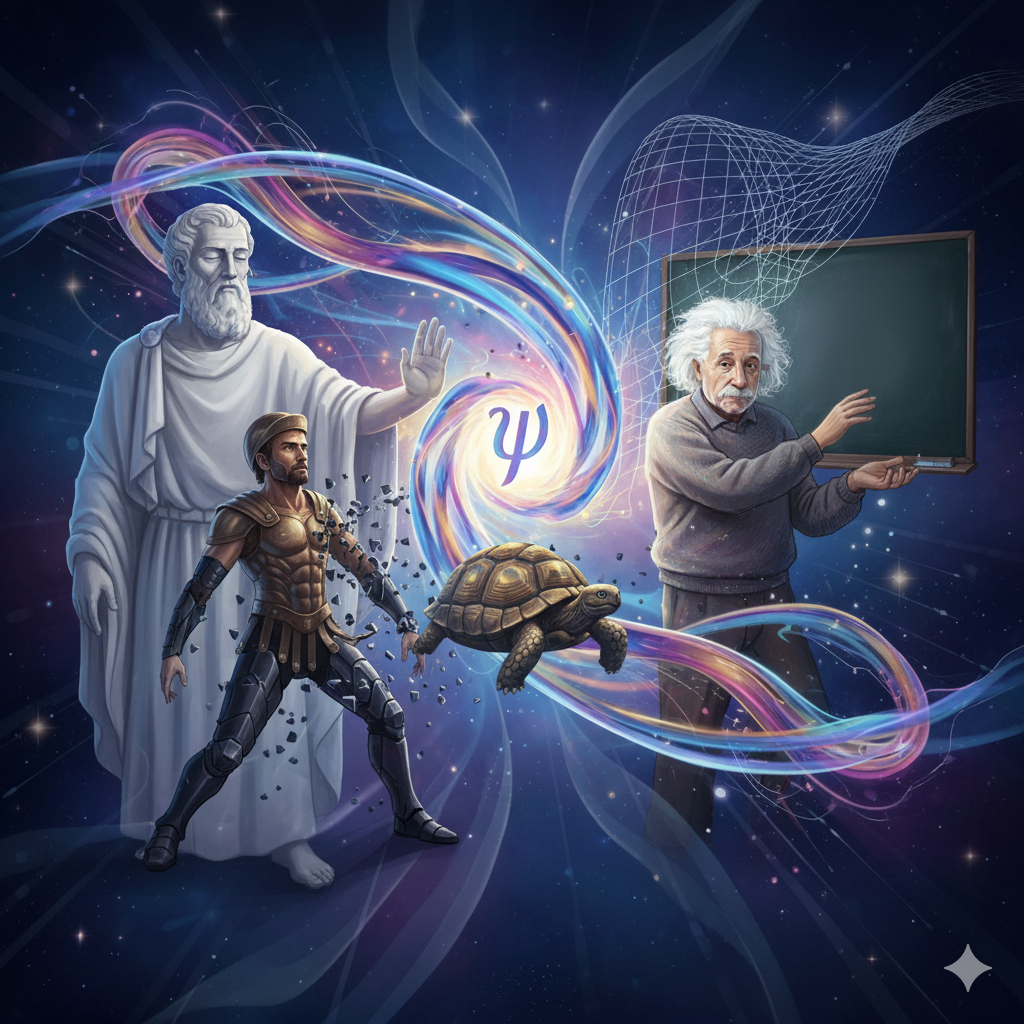
This paper demonstrates that hedonism, by rejecting the Conflict Moment-Impulse (CMI, Δψ), seeks to annihilate the very condition of existence. The ethical imperative of Meta-Monism is not the avoidance of suffering, but the mutual transformation (Tψ) of pleasure (A′) and pain (−A′₀) into higher-order Being (ψ′). True fulfillment is not the absence of tension, but its antifragile resolution.
Introduction: The Hedonic Imperative
In late modernity, the pursuit of pleasure has been elevated to an ontological mandate. Algorithms optimize for engagement, pharmaceuticals promise bliss without cost, and entire economies are structured around the maximization of positive affect. Yet beneath this glossy surface lies a profound philosophical error: the equation of life with the absence of resistance.
Meta-Monism—the ontology of self-differentiating Being—offers a radical counter-diagnosis: pleasure without pain is not fulfillment; it is the negation of the very process that constitutes existence. This paper applies the formal apparatus of Meta-Monism to expose hedonism not as a benign preference, but as a metaphysical pathology—a deliberate regression from dynamic Reality (ψ′) to undifferentiated Chaos (ψ).
The Ontological Structure of Experience
From Chaos to Reality
Meta-Monism begins with the Proto-Act of self-distinction:
Where:
- ψ: Primordial Chaos—undifferentiated fullness, pregnant potentiality
- ¬∅ψ: The act of internal articulation
- Δψ: Conflict Moment-Impulse (CMI)—ontological tension between aspects
- Tψ: Mutual transformation resolving tension
- ψ′: Emergent Reality—higher-order, structured Being
The Two Modalities of Being
The differentiated state ψ′ contains two irreducible modalities:
pleasure, comfort, presence, I-am-here
−A′₀ (Modus “No”): Otherness, localized as Potentiality
suffering, effort, absence, challenge
These are not moral categories but ontological primitives. A′ without −A′₀ is impossible within ψ′—just as a vector requires both magnitude and direction.
Hedonism as Ontological Regression
The Hedonic Program
Hedonism asserts:
In formal terms:
But since ψ′ is defined by Δψ > 0, the hedonistic program is equivalent to:
Consequences of Collapse
In the state ψ:
- No motion (Tψ = 0)
- No creativity (no tension to resolve)
- No self-awareness (no subject-object distinction)
- No happiness—for happiness requires a subject capable of contrast
Thus, hedonism’s promise of “pure pleasure” is self-defeating: it offers a state where pleasure itself becomes meaningless.
The Ethics of Mutual Transformation
The Only Path to Fullness
The only resolution of CMI is through mutual transformation:
Where ψ′′ is a new, more complex configuration of Being.
Concrete Manifestations
- Love: Grief (−A′₀) transforms comfort (A′) into depth
- Work: Fatigue (−A′₀) converts effort into mastery (A′′)
- Learning: Doubt (−A′₀) transmutes confusion into clarity
- Art: Frustration (−A′₀) births beauty (ψ′′)
Without −A′₀, A′ remains sterile. With Tψ, both are elevated.
Antifragility as Ontological Law
Nassim Taleb defines antifragility as systems that gain from disorder. Meta-Monism reveals this as no mere strategy, but the structure of Being itself.
Hedonism, by rejecting −A′₀, cultivates fragility—it removes the very stressors required for growth.
Happiness as Byproduct
It emerges after ψ′′ is born, not before. The runner’s high, the artist’s breakthrough, the lover’s peace after conflict—all are echoes of Tψ, not its aim.
Conclusion: Choose Fullness, Not Escape
Hedonism offers an illusion of escape, but delivers ontological suicide. It mistakes the absence of tension for the presence of life.
Become the forge.
Let pleasure and pain collide.
Let them burn.
Let them birth ψ′′.
This is not suffering for suffering’s sake.
This is Being, alive.
The choice is not between pleasure and pain, but between:
- Static illusion (ψ, hedonism)
- Dynamic fullness (ψ′ → ψ′′ → ⋯, antifragile life)
Choose fullness.