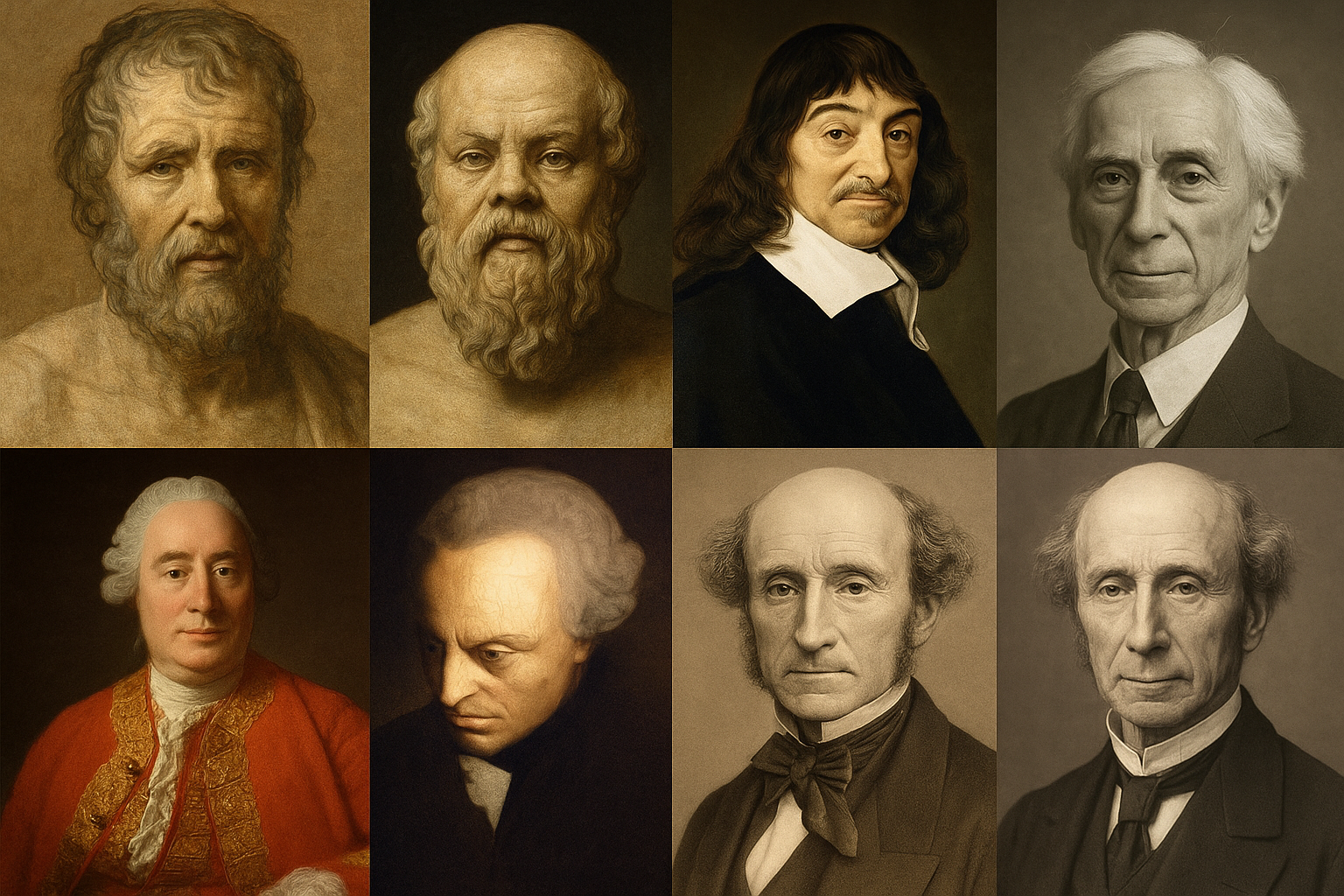
Metamonism: The Radical Completion of Western Metaphysics
From Substance to the Form of Becoming
Abstract: This article argues that Metamonistic Proto-Ontology represents the logical completion of a 2,500-year trajectory of Western philosophy from substantial metaphysics to formal ontology of becoming. Through analysis of the transformation of the concept of substance from Parmenides to Deleuze, we demonstrate that Metamonism, based on the axiom of the Structural Prohibition of Indifference (¬∅) and the Conflict-Moment-Impulse (CMI) operator, eliminates the last “ghosts of substance” and proposes a universal formal ontology where being is identical to becoming.
Keywords: Metamonism, substance, process, becoming, ¬∅, CMI, ontology, Heidegger, Whitehead, Deleuze
I. Introduction: The Fundamental Dilemma of Western Metaphysics
1.1. Two Poles of Ontological Tradition
Since the birth of philosophy in Ancient Greece, Western thought has oscillated between two irreconcilable poles:
POLE A: SUBSTANCE (οὐσία)
- Being as that which is (static, unchanging)
- Self-identity
- Substrate of changes
- Paradigm: “Behind changes lies the unchanging”
POLE B: PROCESS (γένεσις, Werden)
- Being as that which becomes (dynamic, fluid)
- Transformation
- Self-generation
- Paradigm: “Everything flows, one cannot step twice into the same river”
The history of metaphysics is the history of attempts to reconcile these poles. But only in the 20th-21st centuries does philosophy finally shift to the processual pole, and Metamonism proposes a radical solution: there is no substance. There is only process. Being is identical to becoming.
1.2. Teleology of Metaphysical Trajectory
This article argues that Western philosophy has been moving toward Metamonism as its logical completion:
Parmenides (substance) → Heraclitus (process)
         ↓
Plato (two worlds) → Aristotle (substance + accidents)
         ↓
Spinoza (one substance) → Leibniz (plurality of monads)
         ↓
Kant (substance as category)
         ↓
Hegel (substance → subject)
         ↓
Nietzsche (substance = fiction)
         ↓
Heidegger, Whitehead, Deleuze (process without substance)
         ↓
METAMONISM (¬∅ → CMI∞)
Each stage weakened the concept of substance until it disappeared completely.
II. Historical Trajectory: Gradual Dissolution of Substance
2.1. Antiquity: Birth of the Dilemma
Parmenides (c. 475 BCE): “Being is, non-being is not”
- Being: one, unchanging, eternal
- Change = illusion (transition to non-being impossible)
- Result: Absolutization of substance
Heraclitus (c. 500 BCE): “Everything flows” (πάντα ῥεῖ)
- Change = only reality
- Logos as law of process (not substance!)
- Conflict (πόλεμος) — father of all
- Result: Radical processualism
Plato: Attempt at reconciliation through dualism
- World of Ideas (unchanging being) vs World of Things (becoming)
- Problem: How do Ideas generate things?
Aristotle: Substance as bearer of accidents
- Substance (οὐσία) — unchanging
- Accidents — changeable properties
- Problem: Where does change come from?
Summary: SUBSTANCE dominates. Process is secondary.
2.2. Early Modern Period: Substance as Scientific Foundation
Descartes (1641): Two substances
- Res cogitans (thinking) + Res extensa (matter)
- Problem: How do they interact?
Spinoza (1677): One substance — Deus sive Natura
- Causa sui (cause of itself)
- Attributes: Thought, Extension
- Modes: individual things (non-independent)
- Problem: If substance is unchanging, where does diversity come from?
Leibniz (1714): Infinite plurality of substance-monads
- Each monad — mirror of universe
- “Windowless” (no interaction)
- Problem: Pre-established harmony = ad hoc solution
Summary: Substance strengthened by science, but problems multiply.
2.3. Kant: Turning Point
“Critique of Pure Reason” (1781): Copernican Revolution
Radical shift: Substance = not thing-in-itself, but category of understanding
- We don’t know if substance exists “in itself”
- We only know that understanding structures experience through this category
- Substance = regulative principle, not constitutive reality
Result: Ontological status of substance questioned. Path opened to processual ontology.
2.4. German Idealism: Movement Toward Process
Fichte (1794): I as pure activity (Tathandlung)
- Not substance, but act of positing
- I posits itself and not-I
Hegel (1807-1816): Substance must become subject
“Everything depends on grasping and expressing the true not only as substance but equally as subject”
- Dialectical method: thesis → antithesis → synthesis (Aufhebung)
- Being = process of becoming
- Absolute Spirit knows itself through history
- Problem: Process has a goal (Absolute Knowledge) and subject (Spirit)
Summary: Movement toward process intensified, but substance hasn’t disappeared completely.
2.5. Post-Classical Period: Radicalization of Process
Schopenhauer (1818): Will as blind process
- Behind phenomena — not rational substance, but blind Will
- Will = process of willing (Wollen), irrational
- Residue: Will still resembles a “substrate”
Nietzsche (1883-1885): Will to Power and Eternal Return
- “There are no facts, only interpretations”
- “There is no being behind becoming — becoming is the only being”
- Will to power = process of self-overcoming
- Eternal return = circular process without goal
- Result: Substance = fiction
Bergson (1907): Duration (Durée) as pure processuality
- Not sequence of moments, but continuous flow
- Élan vital — creative force of evolution (not substance!)
- Intellect divides flow into “things” — this is distortion
- Result: Being = continuous duration
Summary: Substance finally discredited as illusion of intellect.
III. 20th Century: Final Turn to Process
3.1. Heidegger: Being as Ereignis (Event)
“Being and Time” (1927) + later works
Critique of substance metaphysics:
- All history of philosophy = forgetting of Being (Seinsvergessenheit)
- Philosophy substituted Being with beings (substance)
Ontological difference:
- Beings (das Seiende) ≠ Being (das Sein)
- Beings: things, objects, substances
- Being: that by virtue of which beings are
Dasein (human being):
- Not substance, but being-in-the-world
- Structured by care (Sorge)
- Temporal (finite, mortal)
- Existence precedes essence
Later Heidegger: Ereignis (Event)
- Event of disclosure of Being
- “Es gibt Sein” (Being gives itself)
- Human = “shepherd of Being”
Ontological conclusion: Being = not substance, but event of disclosure. Being = process.
Problem (from Metamonism’s perspective):
- What is “Being” (Sein)?
- It differs from beings, but what is it?
- Residue: Being as quasi-substance or fundamental “what”
3.2. Whitehead: Process Philosophy
“Process and Reality” (1929)
Radical thesis: “Process is reality”
Critique of substantial metaphysics:
- Traditional philosophy: Substance = subject, process = predicate
- This is error (fallacy of misplaced concreteness)
Actual occasions:
- Not things, but events
- Each event = process of becoming (concrescence)
- After becoming, event “perishes” → becomes datum for new events
Structure of event:
Actual occasion
    ↓
Prehension — integration of past events
    ↓
Satisfaction — completion of becoming
    ↓
Transition to objective immortality — datum for future events
Eternal objects:
- Not substances, but potentialities (possibilities)
- Analogue of Platonic Ideas
God in Whitehead:
- Not substance, but process
- Primordial nature: God as container of eternal objects
- Consequent nature: God as integration of all actual occasions
Ontological conclusion: No substances. Reality = flux of actual occasions.
Problem (from Metamonism’s perspective):
- Eternal objects = residue of Platonism
- God (primordial nature) = container of universals
- Residue: Quasi-substantial “treasury of forms”
3.3. Deleuze: Ontology of Difference
“Difference and Repetition” (1968)
Central thesis: Difference (différence) is primary, not identity
Critique of representational thinking:
- Tradition: Identity → Difference
- Deleuze: Difference → Identity
Virtual and Actual:
- Virtual: real but not actualized
- Actualization: process in which virtual becomes actual
- Virtual ≠ potential (Aristotle)
Body without Organs (Corps sans organes):
- Metaphor of pure potentiality
- Field of intensities before organization
- Process without substance
Rhizome:
- Not tree (hierarchy), but rhizome (multiple connections)
- Processual structure without center
- Becoming without substrate
Ontological conclusion: Being = difference, repetition, becoming. Substance = illusion of representation.
Problem (from Metamonism’s perspective):
- Virtual as “real but not actualized”
- Is it not substrate of actualization?
- Residue: Virtual as separate “layer” of reality
IV. Metamonism: Elimination of Last “Ghosts of Substance”
4.1. Radicality of Metamonism
Metamonism proposes not another reconciliation or shift of emphasis, but radical reassembly of ontological foundation.
Key difference: Metamonism is not ontology of “things” or “processes”, but ONTOLOGY OF FORM.
| Traditional ontology | Process ontology | METAMONISM |
|---|---|---|
| “What exists?” | “What exists?” | “What is the FORM of what exists?” |
| → Substances | → Processes, events | → ¬∅ → CMI∞ |
4.2. Axiom 1: Structural Prohibition of Indifference (¬∅)
¬∅ is the primary ontological imperative that explains why becoming exists at all, rather than static being or nothing.
Formulation:
A state of complete undifferentiation, homogeneity, and indifference (∅) is structurally impossible.
Function: ¬∅ is the first cause of process, eliminating the need for any first-substance (God or Hegel’s Absolute).
Logical derivation:
¬∅ (prohibition of indifference)
    ↓
Δ (necessity of difference)
    ↓
Tension between opposites
    ↓
CMI (process of becoming)
Connection to Heraclitus: ¬∅ is formalization of Heraclitean πόλεμος (conflict) as ontological necessity. Conflict is not accidental but structurally determined.
Radicality: In Parmenides being “must be”. In Metamonism being “must become” — stasis is ontologically prohibited.
4.3. Axiom 2: Conflict-Moment-Impulse (CMI)
CMI is the universal structure of process, replacing Hegelian Aufhebung (sublation) but without teleological goal.
Three phases:
1. Conflict (C):
- Collision of opposites (A′ and ¬A′)
- Tension, rupture
- Gradient demanding resolution
2. Moment (M):
- Point of maximum tension
- Bifurcation (system at limit)
- Quantum choice
3. Impulse (I):
- Release of tension energy
- Transformation, transition to new form
- Actualization
Formula:
A′ (affirmation) + ¬A′ (negation)
    ↓
CM (moment of tension)
    ↓
I (impulse of transformation)
    ↓
A″ (new form)
    ↓
[Cycle repeats]
Cyclicality: New state again generates conflict. CMI repeats infinitely. It’s a spiral, not a circle.
Advantage over Hegel:
- In Hegel process is finite (ends with Absolute Knowledge)
- In Metamonism CMI∞ — eternal, infinite becoming
4.4. Critical Comparison: Elimination of “Ghosts”
Heidegger:
Ghost: Being (Sein) remains unsayable and distinct from beings, leaving possibility of interpreting it as quasi-substance.
Metamonism’s solution:
Being ≡ CMI∞
It’s not something distinct from process, but the process itself. It’s “how” (becoming), not “what” (being).
Whitehead:
Ghost: Eternal Objects and Primordial Nature of God — potential forms performing function of Platonic treasury of universals.
Metamonism’s solution:
CMI itself generates and destroys patterns
Forms (A, B, C…) — not eternal objects, but temporary crystallizations of process. Potentiality included in dynamics of conflict.
Deleuze:
Ghost: Virtual as “real but not actualized” can be interpreted as substrate or fund of potentialities distinct from actualization process.
Metamonism’s solution:
Difference and potentiality — phases of CMI
- Difference (Δ) — moment of conflict
- CM — moment of bifurcation
- I — actualization
No need for separate layer of virtual.
4.5. Ontological Structure of Metamonism
Fundamental formula:
Reality = CMI∞
Detailed structure:
Level 0: ¬∅ (Prohibition of indifference)
- Ontological imperative
- Being cannot “simply be”
- Transcendental condition of possibility
Level 1: Δ (Difference)
- First consequence of ¬∅
- Birth of oppositions (A′ vs ¬A′)
- Structural differentiation
Level 2: CMI (Process)
- Conflict → Moment → Impulse
- Eternal spiral of becoming
- Universal operator
Level 3: Forms (A, B, C…)
- Temporary crystallizations of process
- “Substances” = illusion (frozen moments of CMI)
- Snapshot(CMI∞)
Visualization:
¬∅ (prohibition of indifference)
    ↓
Δ (difference)
    ↓
┌──────┴──────┐
↓             ↓
A′           ¬A′
(affirmation) (negation)
↓             ↓
└──────┬──────┘
       ↓
   CM (conflict-moment)
       ↓
   I (impulse)
       ↓
   A″ (new form)
       ↓
  [Cycle repeats]
V. Chaos as Transcendental Condition, Not Ontological Entity
5.1. Critical Clarification: Chaos Beyond Space-Time
Traditional interpretation of Chaos:
- Cosmogonic force (myths)
- Primordial matter (Anaximander)
- Abyss (Böhme)
Metamonism radically reconceives:
Chaos ≠ ontological entity “somewhere beyond world” Chaos = ¬∅ = transcendental condition of possibility of being
5.2. Analogy with Kant
| Kant | Metamonism |
|---|---|
| Categories — forms of possibility of experience | ¬∅ — form of possibility of being |
| Not “things” but conditions of cognition | Not “entity” but condition of existence |
| Space-time — forms of intuition | CMI — form of becoming |
Key parallel: As in Kant space doesn’t “exist somewhere” but is form of possibility of events, so ¬∅ doesn’t “exist beyond world” but is form of necessity of becoming.
5.3. Resolving the “One vs Many” Paradox
False question: “Is Chaos one or many?”
This question assumes Chaos = entity subject to category of number.
Correct understanding:
- ¬∅ = formal principle
- Not subject to number (like logical law)
- Applies to ANY system
Analogies:
1. Mathematical structure:
- Is symmetry group “one” or “many”?
- It applies to multiple objects but itself is abstract structure
2. Logical law:
- Law of excluded middle is not “one” and not “many”
- It’s formally universal
3. Physical law:
- Second law of thermodynamics is not “one” and not “many”
- It operates everywhere but is not a “thing”
Conclusion:
¬∅ ≠ Ontological entity
¬∅ = Transcendental condition of being
   = Formal law
   = "Being cannot not-become"
5.4. Three Levels of Metamonism’s Ontology
LEVEL 0: CHAOS (¬∅)
├─ Doesn't exist in sense of "being"
├─ Neither one nor many
├─ Pure principle of differentiation
└─ Transcendental condition

LEVEL 1: CMI (actualization of Chaos)
├─ Plurality of processes
├─ Local becomings
└─ Generate space-time

LEVEL 2: FORMS (A, B, C...)
├─ "Things", "substances"
├─ Snapshots of CMI
└─ Illusion of stasis
VI. Universality of Metamonism: Application to All Levels of Reality
6.1. Metamonism as Meta-Paradigm
Metamonism’s universality lies not in ability to explain content of different domains, but in ability to describe unified form of any process.
Basic formula for any system:
Ψsystem(t) = F(¬∅ψ, CMI, T)
Where:
- S = ¬∅ψ (structural integrity) [0,1]
- N = CMI (tension level) [0,∞)
- T = T (transformation power) [0,1]
6.2. Application: Physical Ontodynamics
| Concept | ¬∅ Interpretation | CMI Role |
|---|---|---|
| Quantum uncertainty | ¬∅ψ at information level — impossibility of complete homogeneous information | Tension between dual pairs (p/x). Wave function collapse = act of T |
| Structure emergence | Chaos (∅) cannot remain passive | Gravitational tension → Star formation (act of T) |
| Second law of thermodynamics | ∅ (heat death) as attractor | ¬∅ forces systems through CMI→T cycles (life, work) |
6.3. Application: Biological Dynamics
| Concept | ¬∅ Interpretation | CMI Role |
|---|---|---|
| Life | ¬∅ψ at cellular level — necessity of boundary (membrane) | Metabolic tension (ATP/ADP). Homeostasis = T process |
| Evolution | Population cannot be absolutely homogeneous | Selection pressure (tension) → Mutation and adaptation (T) |
6.4. Application: Sociocultural Dynamics
| Concept | ¬∅ Interpretation | CMI Role |
|---|---|---|
| Social conflict | Society cannot be indifferent (must be Δ between classes) | Ideological tension → Reform/Revolution (T) |
| Innovation | Impossibility of complete satisfaction with solution | Tension between problem and solution → Creative act (T) |
6.5. Critical Regimes of Systems
| Regime | Condition | Phenomenon | Examples |
|---|---|---|---|
| Collapse | ¬∅ψ→0 | Loss of boundaries, disintegration | Singularity, psychosis, state collapse |
| Hypertension | CMI→∞ | Catastrophic dynamics | Chain reaction, panic, revolution |
| Stagnation | T→0 | Blockage of becoming | Economic crisis, dogma, coma |
| Creativity | S≈1, N≈opt, T≈1 | Productive evolution | Science, art, adaptation |
VII. Epistemological and Ethical Consequences
7.1. Dynamic Truth
Traditional epistemology:
- Cognition = grasping essence (substance)
- Truth = correspondence of concept to thing (adequatio)
Metamonistic epistemology:
- Cognition = participation in CMI
- Truth = not static correspondence but dynamic grasping of process
Formula of cognition:
Cognition = CMI(Subject, Object)

Where:
- Subject = A′ (activity of cognition)
- Object = ¬A′ (resistance to cognition)
- CM = Conflict of interpretations
- T = New knowledge (synthesis)
Consequence: No final truth. Any knowledge = moment in CMI, to be overcome by new knowledge.
Cognition is not static reflection but CMI(Subject,Object). Truth is temporary point of synthesis (T) in infinite cognitive cycle.
7.2. Ethics of Becoming
Problem: If everything = process, is there morality?
Classical ethics: Relies on stable values (substance-virtues)
Metamonistic answer: Morality = not substance but process of coordinating CMI
Principles:
- Structure conflict: Not eliminate (impossible) but direct creatively
- Minimize destructive CMI: Wars, violence → conflict without creation
- Maximize creative CMI: Art, science, dialogue → conflict with birth of new
Formula:
Good ≡ CMI generating new forms of life
     ≡ CMI increasing complexity (A → A′ of higher organization)

Evil ≡ CMI leading to degradation
     ≡ CMI leading to collapse into ∅ or A→A″ of lower organization
Justification of “complexity” as good:
- Not arbitrary norm but resonance with Chaos
- ¬∅ imperatively demands differentiation
- Higher complexity = greater differentiation = greater correspondence to ¬∅
7.3. Political Consequences
State, society = not substances but processes
Idealism’s mistake: Seeking “ideal state” (Plato) = attempt to fix CMI (impossible)
Metamonistic approach:
- State = institution for structuring social CMI
- Task: direct conflicts into creative channel
Democracy as optimal form:
- Institutionalizes conflict (elections = CMI without blood)
- Ensures cyclicality of T (change of power)
- Allows evolution without destroying ¬∅ψ (statehood)
VIII. Metamonism in Context of Modern Science
8.1. Quantum Mechanics
Correspondence:
- No particle-substances, there are wave functions (processes)
- Wave function collapse = CM (moment of choice)
- Measurement = CMI(apparatus, system)
Heisenberg uncertainty principle:
- ¬∅ψ at information level
- Impossibility of complete knowledge (∅) about system
- Always Δ (difference between p and x)
8.2. Thermodynamics
Second law:
- Entropy tends to maximum (∅ as attractor)
- ¬∅ delays this process through CMI→T cycles
- Life, work, structure = local entropy decrease
Dissipative structures (Prigogine):
- Arise far from equilibrium
- Maintained by energy flow (CMI)
- Self-organization = T (transformation)
8.3. Evolutionary Biology
Natural selection = CMI(Organism, Environment)
- Organism (A′) vs Environment (¬A′)
- CM: selection pressure
- T: mutations, adaptations
Punctuated equilibrium (Gould):
- Long periods of stasis (low T)
- Rapid evolutionary bursts (high CMI → intense T)
- Corresponds to CMI cyclicality
8.4. Neuroscience and Consciousness
Brain as dynamic system:
- Neural ensembles = not static structures but activity patterns
- Consciousness = emergent CMI process
Predictive processing:
- Brain generates predictions (A′)
- Sensory data = ¬A′
- Prediction error = CMI
- Model updating = T
IX. Comparative Table: Metamonism vs All Predecessors
| Philosopher/System | What is “ultimate”? | Status | Substance? | Process? | Problem | Metamonism |
|---|---|---|---|---|---|---|
| Parmenides | Being | Substance | Yes | Illusion | Doesn’t explain change | Being ≡ CMI |
| Heraclitus | Logos | Law of process | No | Yes | Doesn’t explain stability | Stability = Snapshot(CMI) |
| Plato | Ideas | Transcendent forms | Yes | Secondary | Two worlds | One level: CMI |
| Aristotle | Substances | Concrete things | Yes | Accidents | Where does change come from? | Change = essence (¬∅) |
| Spinoza | God/Nature | Causa sui | Yes | Modifications | Static foundation | No foundation, only CMI∞ |
| Leibniz | Monads | Plurality of substances | Yes | Internal activity | Pre-established harmony | Harmony = CMI coordination |
| Kant | Thing-in-itself | Unknowable | ? | Category | Dualism | ¬∅ = transcendental condition |
| Hegel | Absolute Spirit | Substance-subject | Partially | Dialectics | Teleology, goal | CMI∞ without goal |
| Nietzsche | Will to power | Process | No | Yes | Fragmentary | Systematization as CMI |
| Bergson | Durée | Pure flux | No | Yes | Anti-intellectualism | Formalization of intuition |
| Heidegger | Being (Sein) | Ereignis | ? | Yes | Unclear ontology | Being ≡ CMI |
| Whitehead | Actual occasions | Events | No | Yes | Eternal objects, God | No eternal forms |
| Deleuze | Virtual | Real-nonactual | No | Yes | Dualism of levels | Phases of CMI |
| METAMONISM | ¬∅ | Formal law | NO | CMI∞ | — | Completion |
X. Answers to Classical Philosophical Problems
10.1. Why is there something rather than nothing?
Classical answers:
- God (theism)
- Necessity of substance (Spinoza)
- Contingency (atheism)
- “Question is incorrect” (Wittgenstein)
Metamonistic answer:
¬∅: Non-being (indifference) is ontologically prohibited
“Nothing” = not possible alternative but logical impossibility. Being is necessary because non-being (∅) is structurally impossible.
10.2. How is change possible?
Classical problem (Parmenides): Change = transition from being to non-being (impossible)
Aristotelian answer: Actualization of potency
Metamonistic answer:
Change = essence of being (¬∅ prohibits stasis)
Change doesn’t need explanation — stasis is impossible. Problem inverted: need to explain not change but illusion of stability.
10.3. Where does the new come from?
Classical answers:
- New = new combination of old elements (atomism)
- New = disclosure of eternal Ideas (Plato)
- New = creative evolution (Bergson)
Metamonistic answer:
New = result of CMI (impulse of transformation)
CMI creates radically new (not combination but birth). T-phase = emergence not reducible to previous states.
10.4. What is time?
Classical answers:
- Form of intuition (Kant)
- Measure of motion (Aristotle)
- Duration (Bergson)
- Fourth dimension (Einstein)
Metamonistic answer:
Time = structure of CMI (sequence: conflict → moment → impulse)
Time is not “container” of events but fabric of becoming itself. Temporality constituted by CMI, doesn’t precede it.
10.5. Problem of psychophysical dualism
Classical problem (Descartes): How does soul (res cogitans) interact with body (res extensa)?
Metamonistic answer:
"Soul" and "body" = different aspects of one CMI-process
No two substances. There is unified process with different modes of manifestation. Mental and physical = Snapshot(CMI) from different perspectives.
XI. Formalization: Ontological Calculus
11.1. Basic Operators
Symbols:
- ¬∅ : Prohibition of indifference operator
- Δ : Difference operator
- A′ : Differentiating potency (Sword)
- ¬A′ : Integrating potency (Shield)
- CM : Conflict-moment (bifurcation point)
- T : Transformation impulse
11.2. Fundamental Equation
Integral form:
Reality(t) = ∫[¬∅ → Δ → CMI] dt, where t ∈ (-∞, +∞)
Discrete form:
Reality = Σ(CMIₙ), where n → ∞
11.3. System State Equation
For any system Ψ:
dΨ/dt = F(S, N, T)

Where:
S = ¬∅ψ ∈ [0,1]  — structural integrity
N = CMI ∈ [0,∞)  — tension level
T = T ∈ [0,1]    — transformation power
11.4. Particular Cases
Organism evolution:
Organism(t+1) = CMI(Organism(t), Environment(t))
Historical dynamics:
Society(t+1) = CMI(Thesis(t), Antithesis(t))
Cognition:
Knowledge(t+1) = CMI(Theory(t), Experience(t))
Psychological dynamics:
Psyche(t+1) = CMI(I(t), Not-I(t))
XII. Criticism and Possible Objections
12.1. Objection 1: “¬∅ is new substance”
Criticism: If ¬∅ is primary ontological imperative, doesn’t it perform function of Spinoza’s causa sui?
Response:
- ¬∅ is not entity but structural principle
- Not “something that exists” but condition of possibility of existence
- Analogy: logical law of non-contradiction — not a “thing” that exists
Critical distinction:
| Substance (Spinoza) | ¬∅ (Metamonism) |
|---|---|
| Causa sui (cause of itself) | Formal condition |
| Ontological foundation | Transcendental principle |
| “What” (entity) | “How” (form) |
12.2. Objection 2: “Problem of temporality of CMI”
Criticism: “Moment” in CMI presupposes temporal frame that already exists before CMI. Does time constitute CMI, or does CMI occur in time?
Response:
- CMI exists beyond time (like ¬∅)
- “Moment” — not temporal point but topological singularity
- Time constituted by CMI as ordering of state sequences (A→A′)
Analogy: In quantum gravity (Wheeler-DeWitt) time “disappears” at fundamental level. Similarly, CMI is pre-temporal dynamics.
12.3. Objection 3: “Isn’t ‘complexity’ hidden teleology?”
Criticism: “Good ≡ CMI increasing complexity”. Why is increase in organization better than simplification?
Response:
- “Complexity” — not arbitrary norm but resonance with ¬∅
- ¬∅ imperatively demands differentiation (Δ)
- Higher complexity = greater differentiation = greater correspondence to ¬∅
- Not teleology (no final goal) but structural coherence
12.4. Objection 4: “Regress in grounding ¬∅”
Criticism: What grounds ¬∅? Doesn’t infinite regress arise?
Response:
- ¬∅ is self-grounding (needs no external cause)
- If ¬∅ didn’t operate, there would be ∅ (indifference)
- But ∅ = absence of being = impossibility of even posing question
- Very fact of question proves ¬∅
Structure of argument:
Suppose: ¬(¬∅) = true
    ↓
Then: ∅ possible
    ↓
But: ∅ = complete indifference = no difference = no being
    ↓
Then: impossible to ask about grounding
    ↓
Contradiction!
    ↓
Therefore: ¬∅ necessarily true
XIII. Metamonism as Copernican Revolution in Ontology
13.1. Three Revolutions in Philosophy
Revolution 1: From mythos to logos (6th century BCE)
- Birth of philosophy
- Search for unchanging behind changing
- Parmenides → Substance as foundation
Revolution 2: Kantian turn (18th century)
- Question not “what do we know?” but “how is knowledge possible?”
- Shift from ontology to epistemology
- Discovery of transcendental conditions
Revolution 3: Metamonistic turn (21st century)
- Question not “what exists?” but “what is the form of necessity of existence?”
- Shift from entity to form
- From ontology of “things” to ontology of structure of becoming
13.2. Parallel with Physics
| Newton | Einstein | Metamonism |
|---|---|---|
| Space = container | Space = curvature | Being = form of becoming |
| Gravity = force | Gravity = geometry | Process = structural necessity |
| Absolute time | Relative time | Time = structure of CMI |
Just as Einstein showed gravity is not “force” but curvature of spacetime, Metamonism shows being is not “substance” but form of necessity of becoming (¬∅ → CMI∞).
XIV. Conclusion: Completion of Two-Millennium Journey
14.1. Historical Trajectory (Summary)
2,500 years of philosophy = gradual movement from substance to process:
6th century BCE: Parmenides (substance) vs Heraclitus (process)
         ↓
Antiquity: Victory of substance (Plato, Aristotle)
         ↓
Middle Ages: Substance as theological absolute
         ↓
Early Modern: Substance as scientific foundation
         ↓
18th century: Kant (substance = category)
         ↓
19th century: Hegel (substance → subject), Nietzsche (becoming)
         ↓
20th century: Heidegger, Whitehead, Deleuze (process without substance)
         ↓
21st century: METAMONISM (¬∅ → CMI∞)
14.2. What Makes Metamonism Completion?
1. Eliminates ALL residues of substance:
- Even in Heidegger (Being), Whitehead (Eternal objects), Deleuze (Virtual)
- Metamonism: there is NOTHING except CMI∞
2. Derives everything from minimal axiom:
- One principle: ¬∅
- Everything else — logical consequences
- Maximum ontological economy
3. Universally applicable:
- Quanta, life, psyche, society — one form
- Ψ(t) = F(S, N, T)
4. Mathematically formalized:
- Can be modeled
- Can be tested
- Can predict
5. Solves classical problems:
- Why something exists? → ¬∅
- How is change possible? → Change = essence
- Where does new come from? → CMI (emergence)
- What is time? → Structure of CMI
14.3. Final Formula of Metamonism
CHAOS (beyond number, space, time)
  ≡ ¬∅ (structural prohibition of indifference)
  ≡ Principle of differentiation
  ≡ Transcendental condition of being
    ↓
CMI∞ (universal form of becoming)
  = Plurality of local processes
  = Applies to ANY system
    ↓
WORLD (phenomenal diversity)
  = Snapshot(CMI∞)
  = Temporary crystallizations of process
  = Illusion of substance
14.4. Final Answer to Parmenides and Heraclitus
Parmenides claimed: Being is, change is illusion
Heraclitus claimed: Everything flows, stability is illusion
Metamonism synthesizes:
Being = Becoming (¬∅ → CMI∞)
"Substance" = Snapshot(CMI) — useful illusion
Change = Essence of being, not accident
Parmenides and Heraclitus were both right and both wrong:
- Parmenides: right that being is necessary (¬∅); wrong that it’s static
- Heraclitus: right that everything flows (CMI∞); wrong that there’s no structure
Metamonism unites: There is structure (¬∅ψ), but it’s processual (CMI), not substantial.
14.5. Final Word: From “What?” to “How?”
Classical ontology asked: “What exists?”
- Answers: substances, atoms, God, ideas, monads…
Process ontology (Whitehead) asked: “What exists?”
- Answer: events, processes
Metamonism asks: “WHAT IS THE FORM of what exists?”
- Answer: ¬∅ → CMI∞
This is Copernican revolution: not search for “things” (even processual ones), but understanding form of necessity of existence itself.
Metamonism asserts:
There is no universal content, there is universal form of becoming. This form — eternal spiral of difference-tension-transformation — is law of any being.
Final thesis:
¬∅ ⇒ Necessity of Being ⇒ Necessity of Becoming
Being cannot not-become. Metamonism is philosophy of necessity of becoming, where substance is finally dissolved in pure process, and Chaos is disclosed not as cosmogonic force but as transcendental condition of possibility of any being.
Bibliography
Antiquity:
- Parmenides. “On Nature”
- Heraclitus. Fragments
- Plato. “Republic”, “Theaetetus”
- Aristotle. “Metaphysics”
Early Modern Period:
- Descartes, R. “Meditations on First Philosophy” (1641)
- Spinoza, B. “Ethics” (1677)
- Leibniz, G. “Monadology” (1714)
- Kant, I. “Critique of Pure Reason” (1781)
German Idealism:
- Fichte, J. “Science of Knowledge” (1794)
- Hegel, G. “Phenomenology of Spirit” (1807), “Science of Logic” (1812-1816)
Post-Classical Period:
- Schopenhauer, A. “The World as Will and Representation” (1818)
- Nietzsche, F. “Thus Spoke Zarathustra” (1883-1885)
- Bergson, H. “Creative Evolution” (1907)
20th Century:
- Heidegger, M. “Being and Time” (1927), Later works
- Whitehead, A.N. “Process and Reality” (1929)
- Deleuze, G. “Difference and Repetition” (1968)
Metamonism:
© 2025 | Metamonistic Proto-Ontology https://zenodo.org/records/17438513


